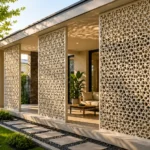
On published density figures, a 15 mm GRC skin works out at roughly 27 to 32 kg per square metre. A stone-faced precast cladding panel, at around 150 mm deep, calculates out near 340 kg per square metre. That is the number the rest of this article explains, because almost every other benefit of glassfibre reinforced concrete follows from it.
Less cladding weight means smaller brackets, lighter slab edges, less steel in the frame, smaller foundations and faster crane cycles. It is not an aesthetic argument. It is a structural one that shows up in the bill of quantities.
But the weight saving is also the benefit most often oversold, so this piece covers what GRC genuinely does well, and the three places where the marketing runs ahead of the material.
What GRC actually is
Glassfibre reinforced concrete (GRC, also called GFRC in American usage) is a thin-section cementitious composite: cement, fine sand, water, admixtures and alkali-resistant glass fibre, sometimes with an acrylic polymer.
The critical word is alkali-resistant. Hydrating Portland cement produces a strongly alkaline pore solution, and ordinary E-glass fibre is progressively attacked by it. AR glass resists that attack because of its zirconia content, and the International Glassfibre Reinforced Concrete Association specifies a minimum zirconium dioxide content of 16%. Fibre below that threshold is not GRC fibre, whatever a supplier calls it.
That single material choice is what makes thin sections possible. Conventional reinforced concrete needs cover over its steel, and Indian practice under IS 456 makes sections thinner than about 40 mm impossible. Because GRC’s reinforcement is dispersed through the matrix as short fibres with no corrosion risk, it can be built at 10 to 15 mm.
Where the benefits actually come from
Dead load, and everything downstream of it. GRCA density figures put GRC at a minimum 1800 kg/m³ dry. A complete stud-frame system — GRC skin, steel backing frame and anchors — is commonly quoted around 40 to 50 kg/m², against roughly 240 kg/m² for a 100 mm precast panel and higher for stone-faced precast. Call it a five- to sevenfold reduction in cladding dead load. On a tower facade that is a structural decision, not a finishing one.
Mould-based repeatability. This is the benefit that architects value most and that datasheets rarely list. Once a mould exists, the hundredth unit matches the first. For a facade built on a repeating module — a jali screen, a fin, a cornice, a column capital — the mould cost amortises across the run and the geometry stays consistent in a way hand-carved stone cannot match. Complex curvature and deep relief that would be prohibitive in stone become a mould problem instead of a labour problem.
Factory production, with the quality control that implies. GRC is made under cover to a controlled mix, not troweled on site. That means dimensional tolerances, documented curing and traceable batches, and it means facade elements can be fabricated while the frame is still going up rather than after.
Fire behaviour that polymer composites cannot match. GRC is a cementitious material, which puts it in a different class from GFRP or FRP where reaction-to-fire is concerned. A word of caution on the specifics, below.
Carbonation resistance. Independent testing reported by GRC UK shows the rate of carbonation in GRC to be around 90% lower than in other forms of precast concrete over a given period, and while GRC’s water absorption is similar to other concretes, its water permeability is significantly lower. For an Indian urban facade dealing with monsoon cycling and atmospheric pollution, permeability matters more than absorption.
The properties a specifier should actually ask for
Here is where a lot of GRC discussion goes wrong. People ask for compressive strength, because that is the number they ask for on concrete.
Compressive strength is not a design parameter for GRC. The GRCA specification does not list it and the design guide does not tabulate it, for the straightforward reason that a 10 mm skin does not fail in compression. The meaningful figures are Limit of Proportionality, the point at which the matrix begins to crack, and Modulus of Rupture, the ultimate bending strength.
Characteristic values from the GRCA specification:
Grade, LOP & MOR Specifications
| Grade | LOP | MOR |
| 8 / 8P | 5 MPa | 8 MPa |
| 10 / 10P | 6 MPa | 10 MPa |
| 18 / 18P | 7 MPa | 18 MPa |
Manufacturing method drives which grade you can have. Sprayed GRC, at 4.0 to 5.5% fibre by weight, reaches MOR values of 18 to 30 MPa. Premix, vibration-cast at 2.0 to 3.5% fibre, achieves only 5 to 14 MPa. Spray for cladding panels carrying wind load; premix for small, intricate cast items where a spray gun cannot reach into the mould.
If a quotation does not state the grade and the manufacturing method, it is not a specification. It is a price.
Other figures worth having on the datasheet: dry bulk density (GRCA minimum 1800 kg/m³), water absorption (GRCA gives 5 to 11%, though individual product datasheets run higher at 8 to 13% — ask for the tested value rather than the range), thermal expansion coefficient of 10 to 20 × 10⁻⁶ per °C, and ultimate shrinkage, which can reach 0.2% depending on mix.
Three things the marketing gets wrong
Being honest about these is more useful than another list of advantages, and it is how you avoid a specification argument at handover.
One: the fire classification is not automatically A1. GRC is cementitious and non-combustible in the ordinary sense, but polymer-modified grades, the “P” grades, contain organic content, and product datasheets for Grade 18P commonly declare A2-s1,d0 to BS EN 13501-1 rather than A1. Non-polymer GRC can reach A1. Never accept “A1” as a generic claim about GRC; ask for the specific product’s EN 13501-1 test report, because the answer depends on that product’s polymer content.
Two: GRC gets stronger and then more brittle. This is real and it is designed for, but suppliers rarely mention it. Over decades, GRC’s ultimate bending strength falls while its LOP rises — the material embrittles. Panels from 30 Cannon Street in London, installed in 1974 and designed for a 25-year life, showed a drop in MOR of approximately 50% after 28 years. The expected loss is defined in BS EN 15191, and it is precisely why the GRCA design guide works in limit state theory using aged values rather than 28-day test results. A designer using fresh MOR figures for a 40-year facade is doing it wrong. Ask whether the design used aged values.
Three: lighter does not automatically mean lower carbon. GRC is cement-rich and aggregate-poor, so per kilogram its embodied carbon is higher than ordinary concrete. The environmental case rests entirely on using far fewer kilograms. That case is often good, but it is an arithmetic argument that needs the actual numbers from an Environmental Product Declaration, not an assumption. Mahesh GRC or any other manufacturer should be able to hand you an EPD; treat a carbon claim without one as marketing.
How GRC compares with the alternatives
| Material | Weight | Repeatability | Design Freedom | Fire Class |
| GRC | Low | Excellent | High | A1 or A2, product-specific |
| Precast Concrete | Very high | Good | Moderate | A1 |
| Natural Stone | High | Poor | Low | A1 |
| Terracotta | Moderate | Good | Moderate | A1 |
| Aluminium | Very low | Excellent | High | A1 or A2, system-specific |
| GFRP / FRP | Very low | Excellent | Very high | Combustible |
Stone wins on authenticity and on a weathering record measured in centuries; nothing else has that. Aluminium is lighter and quicker, but it reads thin and moves more. GFRP is lighter and more mouldable than GRC and loses on fire classification, which in a commercial facade is often decisive.
GRC’s position is specific: the mass and finish of concrete or stone, at a fraction of the weight, with mould repeatability and factory control, and without the fire-classification problem that polymer composites carry.
The standards question, and why it matters in India
There is no BIS or IS standard for GRC. Checking the relevant BIS committee for cement matrix products, the fibre-cement standards that exist are IS 14862:2000 for flat sheets and IS 14871:2000 for corrugated roofing and cladding sheets, and neither covers GRC. IS 18256:2023 covers glassfibre reinforced polymer rebar, which is a different material altogether and is frequently confused with GRC in tender documents.
That absence has a practical consequence: an Indian project must specify GRC against the European and GRCA framework by name, or it has not specified anything testable.
Get these into the specification: the GRCA specification for manufacture, curing and testing; EN 1169 for factory production control; EN 1170 for test methods; EN 15191 for performance classification. Note the edition dates, because all three EN standards were revised in 2024 and the older editions — EN 1169:1999, the EN 1170 parts from 1998 and 2008, and EN 15191:2009 — are withdrawn. A specification copied from a 2021-era document is citing standards that no longer exist.
The Indian codes that do apply are the ones governing everything around the GRC: IS 15916:2020 for design and erection using prefabricated concrete, IS 456 for the supporting frame and fixing substrate, and IS 875 Part 3:2015 for wind loading. Wind is worth a line of its own — facade panels are designed for local external pressure coefficients at corners, edges and parapets, which are substantially higher than the coefficients acting on the body of the facade. That is why corner panels are specified differently from field panels, and why a single panel thickness across a whole elevation is a warning sign.
Common questions
Nothing. GRC is the British and international term, GFRC the American one, for the same glassfibre reinforced cementitious composite.
Single-skin GRC is commonly 10 to 15 mm. Overall panel depth is greater where ribs, returns or a backing frame are included.
It is a different question. GRC is far stronger in bending per unit of thickness, which is what lets it work at 10 to 15 mm, but compressive strength is not how GRC is specified or designed. Compare LOP and MOR, not compressive strength.
GRC is cementitious and non-combustible in the ordinary sense, but the formal classification depends on the product. Polymer-modified grades commonly test at A2-s1,d0 to EN 13501-1; non-polymer grades can achieve A1. Ask for the test report for the specific product.
Facade GRC has a service record going back to the 1970s. Its ultimate bending strength declines over decades while the material embrittles, which is why competent design uses aged values under EN 15191 rather than 28-day figures. Any supplier quoting a flat service life without reference to aged design values is guessing.
No. Specify against the GRCA specification and EN 1169, EN 1170 and EN 15191, using the 2024 editions.
What to do with this
If you are evaluating GRC for a project, the single most useful thing you can do is ask three questions of any prospective supplier: what grade and manufacturing method, what does the EN 13501-1 report say, and were the panels designed using aged values under EN 15191. The answers separate manufacturers quickly.
For a project in Delhi NCR, Mahesh GRC’s team in Gurugram can walk through grade selection, panel typology and fixing strategy against your actual elevation and wind exposure, and provide the test documentation to go with it.
This article is general technical information for architects, engineers and specifiers, not a design document. Material properties vary between manufacturers, grades and production methods, and structural design for cladding must be carried out by a qualified engineer against project-specific loading. Standards are cited as at August 2026 and are periodically revised; verify current editions before writing a specification.